Thursday, December 14, 2017

The Screen Door Slams


Bruce Springsteen on Broadway
Walter Kerr Theater, New York City

by Kevin Salem
Let’s not dwell on the setup. Briefly, though, as a young punk, I sold a guitar amp to the Boss during one of his many appearances in my hometown of Johnstown, PA. I was not a fan. In fact, I was a detractor, so when his manager asked if I wanted a ticket to his show that night, I proudly refused. That’s as close as I’d ever come to seeing a Springsteen show. Over the years, through the brilliance of Nebraska, Darkness on the Edge of Town and a few other offerings– most notably, the first 10 minutes of the Hammersmith ’75 video– I have become, if not a full-fledged fan, a repentant appreciator. So when a dear friend offered me a ticket to see Springsteen on Broadway, I decided it was time to put an exclamation point on my conversion.


Sadly– or perhaps proudly– I must report that I still have not seen a Springsteen concert, and it’s likely I never will. Funnily, my friend, a Parisian musician and Bruce fanatic who had not previously seen a Broadway production can at least say he lost his Great White Virginity. Despite the fact that he performed 10 or so of his most iconic songs, Springsteen on Broadway is more Broadway than Springsteen. Regular Guy Bruce took the stage in black jeans and tee, without makeup, and began a monologue about his New Jersey roots. Springsteen has honed his vision of America in song, political campaigning and interviews with great care over the years. My hometown, once the center of the steel and coal industries, appears in many of his lyrics because of its decline and fall as much as its proto-working class image. On my way to Times Square, my anticipation was interrupted by a daymare, a vision of a crazy on violent rampage in central Manhattan, culminating with the public assassination of the Boss. Please don’t ask why, as I have no explanation, apart from my unconscious anticipation of this; from the moment he began speaking, it was clear that Springsteen’s American narrative has been rendered obsolete by decades of uber-conservative dominoes falling and the chaotic collapse that is Donald Trump. The communities and economies that shaped his vision of us were only possible because of what we did not acknowledge; that that church around the corner was a hotbed of sexual abuse and homophobia, that the business of public education was a training ground for laborers who would see their wages stripped by greedy CEO’s, that children born after 2001 may never live a day in a country not at war, that Bedford Falls has ultimately lost to Mr. Potter. I’m not trying to be a downer, and I wish it weren’t so, but it is. Those who failed to accept that Born in the USA is a protest song can rest easy, knowing they own the country, at least for now.
My hometown. (Walker Evans)

“In boardwalk towns, everything has a tinge of fraud.” This was Springsteen’s first pronouncement. Throughout the course of the show, he verified his humility by admitting to his own. “The guy that wrote Born to Run lives 10 minutes from his hometown,” and, “I’ve never seen the inside of a factory, never worked in one, never even worked five days a week until now... and I don’t like it.” As much as these lines were greeted with the laughter that they were intended to elicit, the honesty at their core was refreshing in a world where lesser “great” men are parading to microphones daily (or not) to cop to their indiscretions. Broadway has a way of making everything milquetoast, and that is the shame of Springsteen on Broadway. The Boss was genial and polite, even apolitical, because this was, by definition, not rock and roll. But to categorize it as purely theatrical would deny Springsteen’s integrity. So, at its best, it felt like gratitude, a (final?) high five to his loyal fans from one of the most adored musicians of our time. Springsteen spent fifty years telling his audience’s story, giving them a voice among the cool, and this read like an epilogue. 

The story of how he discovered Rock & Roll is not substantially different than any other musician’s I know. It starts with a spark of inspiration– for me, it was seeing a band of teens at a church picnic playing “Little Bit O Soul,” for him, it was seeing Elvis on TV– before progressing to the trip to the music store with mom, the posing in front of the mirror, and ultimately the obsession. I never mind hearing this story, but I did kind of cringe at hearing it recited over an E chord pedal in the middle of “Growing Up.” Really, that’s just me being a dick, but why not just let the song tell the story? And I guess this is really the crux of my feelings about the show. If I’ve resisted Springsteen, it’s because I am not much for “on-the-nose” in a medium where there are so many tools of allusion at our fingertips. Why explain shit to death? 

On a purely musical level, though, there was one stretch of five minutes that was truly stunning. Springsteen met Ron Kovic by chance, and Kovic, as the story goes, took him to a VA hospital. When Bruce introduced “Born in the USA” as a soldier’s blues, a protest song, his veneer cracked, and the palpable impatience with its misuse as a theme song for empire builders was unmistakable and refreshingly tense. One of the things about this guy that is seldom mentioned is that he is a great guitar player. Not competent, not just good... he can fucking play. After a couple minutes of absolutely blistering and authentic slide guitar, the lyric was quietly delivered as an a capella blues. By quiet, I mean not quiet at all, but like a lid held on a pot that desperately needs to boil over. It was greatness, and no matter my taste, my history, my expectations or the setting, there is no denying greatness. I would be an idiot to try and bullshit away Springsteen’s.
Here, for the diehards, is a list of the songs: 

1. "Growin' Up"
2. "My Hometown"
3. "My Father's House"
4. "The Wish"
5. "Thunder Road"
6. "The Promised Land"
7. "Born in the U.S.A."
8. "Tenth Avenue Freeze-Out"
9. "Tougher Than the Rest"
10. "Brilliant Disguise"
11. "The Rising"
12. "Long Walk Home"
 13. "Dancing in the Dark"
14. "Land of Hope and Dreams"
15. "Born to Run"

Though nothing touched the brilliance of “Born in the USA,” there were some great performances and many reminders that the Boss can still sing his ass off. But it was about the story. It was about his love of Rock & Roll, his America, his band, his family, his life. He listed a few things it takes to be a musician. The last was, “You need a special trick.” For fifty years, he’s made people think he’s telling their story for them, and that, he claims, is his trick. But for two hours, he exposed his “fraud” and walked back and forth between the piano and guitar with the gait of a seventy year old man. Allowing himself to let go of his superhero status, for me, was a better trick, and it took me writing this to understand that, even though it was the mass-mediated version of him, there are reasons to acknowledge his importance.


Tuesday, December 12, 2017

Death to the Pixies!


It’s a sad thing, but when you grow up, you no longer want to live in a town where there are nightclubs and shows by bands you want to see happening nearby. The reason is that there is a very tedious everyday burden that goes along with that stuff – high rents, no parking, space issues, random people yelling insults at you all the time -- that palls with age. That said, having left that milieu, it takes a special sort of gumption to then want to drive an hour plus to a place to see a good band on a Monday night -- and over a twisty, mountainous road, too. There’s not a lot of bands I’d do that for, especially in the winter, but there is one and its name is The Pixies.
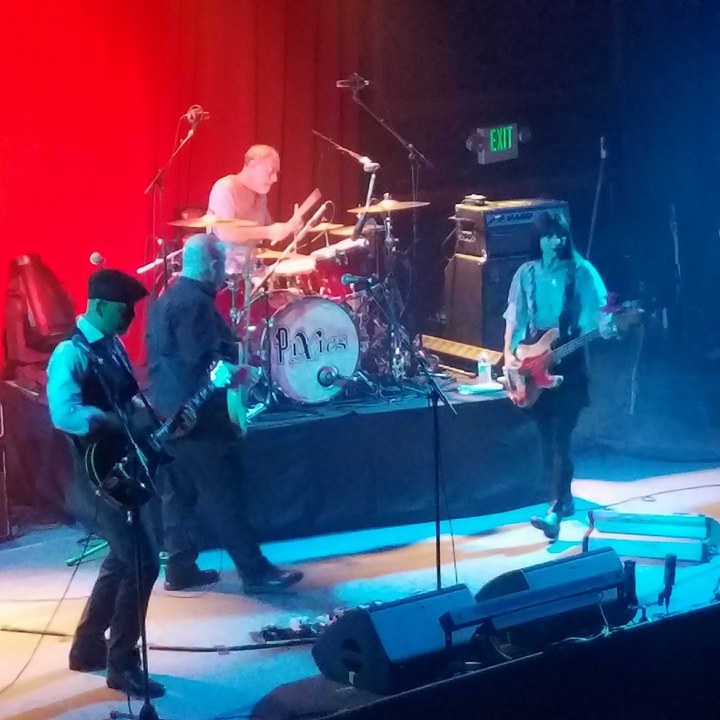
The Pixies at the Catalyst, Santa Cruz. 12/11/17

The Pixies have turned into this generation’s Velvet Underground, or more accurately, Nirvana, only with this twist…they’re still alive and kicking. You know how I knew that the Pixies had transcended their place in the zeitgeist? It was when I was at a graduate student’s party at Stanford in the mid-2000s, and we were having a discussion about the most illegal things we’d ever done. Being Stanford, not a single one of the students had ever done anything illegal, but the professor, James Curran, had once been arrested for protesting the Falklands War or something.

Then everyone looked at me, because, well, you know, I’m old too, so stuff has happened to me. I told them I’d never been arrested. “But I once crossed the Alps in a tour bus with a band without my passport and I thought I was going to be.”

Them: “Oh, what band?”

Me: “Just one you’ve never heard of.”

Them: “Try us.’

Me: “They were called The Pixies.”

And I swear to god a hush fell on the room. It was exactly as if I’d said the Beatles or the Stones, and I was utterly flabbergasted, because in 1991, when the incident I was referring to occurred, the Pixies were never played on the radio, and never spoken of in the press. They were beloved, yeah, but only by a very small sect of people; when you went to see them, you knew everyone in the audience. They were bigger in Europe, and the show I saw in Vienna (after I’d crossed the border illegally) was probably the best show I ever saw in my life and if you know me and my life, you know that’s saying something.

The point is, by 2006 even Stanford graduate students had heard of them, and today, reunited, the Pixies are well worth a drive over a mountain pass in mid-winter, because they are the band that opened it all up for me. Back in the day, I don’t think you could hear them and not have come away changed. Indeed, I remember exactly where I was when I heard their 4D debut EP, and exactly what I was doing. It was in this weird apartment on 20th Street and Shotwell in San Francisco that I lived in for such a brief period of time that I only have two distinct memories of it, one of finding out that ML died in a plane crash, and the other of listening to the Pixies. I remember staring and staring at the album cover, which depicted Black Francis’s hairy naked back, and wondering a lot about “Mrs. John Murphy.” Who would call themselves that, even as a joke? I remember hearing “Caribou” and “Levitate Me” with rapturous awe, and receiving the first LP “Surfer Rosa” soon after, barely able to contain myself in my rush to put it on. There was nothing like it at the time, nothing. A couple of years later, I asked Charles (Black Francis), awkwardly, how one went about being original in rock music, when so much has already been said and done in that idiom. I think I put it differently, and I see now what a dumb question it was – like all those dumb sports interviews you hear, ‘how does it feel to be WORLD CHAMPIONS?’ – and all he said was something like, ‘Um, what I can’t understand is, how can one NOT be?”

But that was later, on that fateful European tour, for a story that was never published and which I am afraid was probably the best thing I ever wrote. It is now lost to antiquity, because I didn’t write it on a computer, folks. So, now we’ll never know what he said or I did, because I don’t have the records, or even the set lists that I grabbed from the stage every night as they made their way across Central Europe.
lost my passport here

Instead, here I am at the Catalyst, in downtown Santa Cruz, having crossed another mountain range in the middle of the night, standing on the balcony at the top of the steps on the bar side, next to two very nice women who were discussing a recent LCD Sound System show with great intensity. Then the show began, and at first I was let down. The sound was poor (although it was good where I was) and the band was lukewarm, trying to deal with that. They began with “Gouge Away,” then “Wave of Mutilation” and it took them some six to eight songs to get into a groove. But then: they did. At some point, it all fell into that place of power from whence I remember them – maybe not the same supersonic split-the-universe-open place I saw them at in Vienna, but somewhere in that vicinity, and surely close enough for the audience, most of whom weren’t even born back then and who, on this night, were therefore…beset. Wild. Tremening with it, both above and below, in a pit that gaped open at the first crack on the drum. The LCD women hugged each other. A guy near me began to bang his head. A chair crashed down the steps. Howling commenced. “Caribooooo.” It felt momentous, more like participating in history than in a concert.

The Pixies' first five records, “Come On Pilgrim,’ “Surfer Rosa,” “Doolittle,” “Bossa Nova” and “Trompe Le Monde” are tattooed into my cochleas. Everything after, not. I thought the new songs sounded good as hell though; I nearly bought the CD on my way out. Still it is surprising to me how very much into the old stuff the audience was. It knew every single track, from the earliest possible moment in the band’s career, and it was those songs, like “The Holiday Song,” and “Vamos” and “Nimrod’s Son” which are from “Come On Pilgrim,” that were like explosions under the feet of the pitsters, tossing them out and up on sound waves that rocketed and bucketed the rest of us as well. The entire audience was chanting “YOU ARE THE SON OF A MOTHER FUCKER.” The set drew so heavily from the 4 AD years that it is easier to list songs they didn’t play than ones they did (no “Dig for Fire” boo hoo): it was the longest Pixies show I ever saw, almost hitting 40 songs, no joke. It went on and on and on, and there was no such thing as a bad song in it. The very last thing they played was “Debaser,” and by that time I had honestly had forgotten all about it: instead of sounding like the song that launched an entire David Bowie album, it sounded like a throwaway. Ha!

By that time though, I had left my perch in the balcony and was slowly backing out of the club, drawn slightly forward for each encore, like, “Hey!” The Catalyst is long and narrow, and usually about the back third of it is just one long disinterested extension of the bar, just people chatting each other up, but not on this night. On this night, the whole audience pressed forward as one big loving chest. So many bands that reunite, you think, well, they’re doing it for themselves and for the money, and that’s fine. The Pixies, may well also be doing it for the sake of their fans, so many of whom can’t simply fucking believe it...weaned on Weezer or whatever, they can’t believe what it turns out a really good band is like. I mean, it defies belief. It sounds crazy, but at the end of the Pixies almost 2 hour long set, 40 songs deep (!!!), the band dropped their instruments and stood in a line to take a bow and the audience just stood their stomping and cheering and clapping and howling for, like five full minutes. FIVE MINUTES. I tried to remember when I’d seen that before and it was…oh yeah, it was at the Pixies' first Fillmore show in 1989.

As that indicates, despite the years that show on their faces, many things about the Pixies are still the same. Like, they still play “Wave of Mutilation” twice, and the band still does not speak. At all. They just play short bursts of songs, many of them sans melody, and you realize as you listen that a good enough band can dispense with melody, because other things – fucked up tempos, re-tunings, super interesting guitar runs, yelped-out images about magical creatures, outer space and the desert, the Bible, and nonsense shrieked in Spanish will obliterate any need for something as facile as a tune. Then, on the occasions when the Pixies put in a melody, or, god forbid, a meaning, the whole thing blows sky high. I mean, IS there a better song for our times than “Monkey Gone To Heaven”? “Now there’s a hole in the sky and the ground’s not cold, and if the ground’s not cold then everything’s gonna burn, we’ll all take turns, I’ll get mine too…” When they got the chorus, the entire audience thrust its fingers in the air as one: 5 -5- 5. 6 -6- 6-. 7 - 7- 7. It was simultaneously beatific and satanic, chaotic and melodic, it was black and white and red all over. It should be the theme song for a ‘see ya’ show about 2017.

As for the new (“new”) bassist Paz Lenchantin, she didn’t even make me miss Kim Deal, like I thought she would. Obviously, there is no question that the Pixies couldn’t have existed in the first place without Kim Deal, but having seen Kim and her band only a few weeks ago, it’s easy to feel supremely good about the place she is in right now, and that makes it feel OK to watch someone else take her place. It’s different though. Kim just stood on stage stock still and radiated power and heat. Then she would step forward, beam, and sing like an angel, thus mitigating the sheer furious intensity of Charles, who looked like a deranged serial killer whose neck veins stand out as he shrieks. Clearly, the total genius of that juxtaposition simply can’t be equaled, but the Pixies aren’t trying to. Paz may not really be adding anything new to the band, but she sure looks fantastic. If I was going to be a bassist in a hard rock band, I’d try to look exactly like her. I’d wear a pleated black skirt, but not a booty short one, and super nice flat boots, and – even if I wasn’t a bassist -- if I could have the pick of all possible types of hair in the whole world, I would pick hers. I would probably play just like her too. I’d rock out to every number, as if I knew – as she must know – that I'd fallen into the best possible job in the whole wide world. No doubt she is an accomplished musician in her own right (she played with A Perfect Circle and Zwan), but her strength is that she makes playing bass in the Pixies look positively doable, and I mean that in the best possible way.

Last summer I was in Vienna for one single night, to see the Afghan Whigs. It was my first time in that country since the night I saw the Pixies, and in the morning, I was riding around on a bike and I happened to pass the US Embassy. It didn’t look even remotely familiar to me, but I knew I was there once, 27 years ago, to get my passport reissued after I’d lost mine in the crush at a Pixies show in Germany. In those days you weren’t supposed to cross borders without a passport, and boy did that consulate yell at me for doing it; he tore me a new asshole as he deported my ass back to America. But it was all OK, because, like I said, the Pixies changed me. For me, there will always be a before and an after. The Pixies showed me that all the bad things you can ever envision can happen to you on the road, but you won’t die; in fact, quite the opposite, the things that happen will just make you more into living. Long live the Pixies.