Monday, October 16, 2017

Song of the Week #1 and #2 (Oct. 8-15)


“I Know What Boys Like.” (Oct. 9)

This blog has generated a certain amount of fury amongst my friends (and enemies) because of the controversial nature of its thesis, which postulates that Cheap Trick are not in fact the best band on earth. Across all the discussion and arguments I have had this week about boys, bands, Cheap Trick and 70s rock, there is one single consensus item and that is that this is one great song: 


("Surrender," by Cheap Trick, from the LP "Heaven Tonight." 1978.)

This short review of the Afghan Whigs show at the Fillmore, only posted at Medium, mentions in passing the stellar presence of Marcy Mays, who made a guest appearance mid-show to sing the song “My Curse" and fucking crushed it. Seeing her sing last week reminded me of her band Scrawl, who were a very awesome female presence in the pre-grunge world of indie rock, and who definitely deserve a little more belated love. So for those who missed them the first time around, here they are, in all their glory:


 "Charles," by Scrawl. From the LP "Smallmouth." Rough Trade Records, 1990.

Wednesday, October 11, 2017

I Know What Boys Like


Last Sunday, I went to Golden Gate Park to see Cheap Trick perform for free. I don’t know what possessed me to do that – I think I thought I liked Cheap Trick better than I actually do. Actually, I don’t. Like them, I mean. They are a boy’s band. There was a time, though, when I was a teenager, when I only liked the records that boys like. It wasn’t exactly deliberate, but of course that was all I ever heard about, since boys were the only ones who told me about bands.
do you remember laughter?

Cheap Trick are a case in point. I think I probably heard about them from Creem magazine, and what I heard was that they were such an awesome band. Creem being my Bible, I wouldn’t have dreamed of questioning that opinion about them. But I can faintly remember listening to one of their songs, “I Want You To Want Me,” or “Dream Police,” and secretly thinking, wait, why is this supposed to be good? But, I thought, something was good about it, or there wouldn’t have been such unanimity about that opinion. I think I thought the same thing about Ernest Hemingway.

Musically, Cheap Trick fell into a big bucket of bands that weren’t considered good – bands like REO Speedwagon, Foreigner and Journey. Also, Boston, Kansas, and April Wine. The only difference I could determine between those ‘bad’ bands was that Cheap Trick – like Kiss -- sort of dressed up. There was one who wore a hat, and one who wore a glasses, and two who were “cute” – that is to say, I was supposed to think they were cute, though in fact, I didn’t. (Note: this was in the days before videos, so all we knew about them, and their costumes, was from their album covers.)

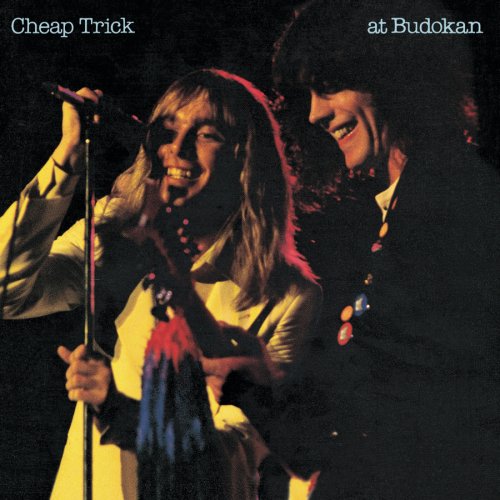
Creem liked Kiss a lot, also, but I understood that to be an ironic stance. I don’t think they were being ironic about Cheap Trick, although “Cheap Trick at Budokan,” the band’s best-selling record, was originally pressed on colored vinyl, a novelty at the time, and the background screaming of 12,000 Japanese fans was clearly meant as kitsch. In 1978, it sold 3 million copies, which certainly helped me somehow internalized the idea that Cheap Trick was a really good band.

Then I never thought about them again until last week, when they appeared on the bill of Hardly Strictly Bluegrass.

Having them on the roster seemed like a funny and cute idea: they are so far from hippies. So far from folkies. So far from anything you associate with free festivals in Golden Gate Park, although at the same time that they bleach the genre, one can’t deny they play the epitome of a certain kind of American Music. It seemed like it would be a real laugh, and as it was a beautiful day last Sunday and I had nothing else to do, around three in the afternoon, I dashed over the Park, getting there so fast that I had time to drop by the Rooster Stage to see the Bob Mould Band. That was interesting, especially as he played three Husker Du songs in the first six minutes. Do you know what hearing Husker Du is like to me now? It’s akin to hearing the theme song from “Totoro” or the Hello Kitty song from the videos my daughter watched as a baby. It gives me that indescribable fuzzy feeling of awwwwwwww, where your stomach clenches and you tear up a little.

I feel this may not have been the case for the majority of Hardly Strictly attendees who were at the Rooster stage right then, some of whom were leftover from the Emmylou Harris-Steve Earle - Bob Weir-augmented super group who had just finished playing Tom Petty songs. To them, Mould’s trademark power trio/tuneful thrash sound may have sounded strangely un-funky, unfolky, and definitely white  - though I did see a hippie couple attempting to boogie to “I Apologize.” I don’t think the whole point of Husker Du has made it down through the ages in the same way the Tom Petty’s point has – but for a very few of us in that glade that afternoon, “Never Talking To You Again” was Free-Falling-esque.

The best fucking...oh, whoops.
Thanks to the magic of twitter, I ran into my friends Tim and Donna at the Rooster stage, and the three of us decided to hoof it to the Cheap Trick stage before Bob Mould was done, passing by Courtney Barnett and Kurt Vile in transit. We found a nice place on a grassy green hillside to spread our blanket, and busted out some nachos and salsa.  

It was super nice on that hillside, surrounded by sunshine, and the incongruity of it all had somehow convinced me that Cheap Trick would provide one of those Only-At-Hardly moments, like when Dolly Parton played “Where Have All The Flowers Gone” or when Marianne Faithfull sings “Down to Dover,” but in practice, it wasn’t quite that transformative. Indeed,  their more ironic moments fell a bit flat, as when the band appeared on stage foreshadowed by an announcement by a sultry female voice saying, “Ladies And Gentlemen, introducing the best fucking rock band you’ve ever seen!” That statement just doesn’t work that well when the crowd has just seen Big Freedia, Ozomatli, or kinda-sorta Husker Du.

 Also, some bands can pull off playing in daylight better. Sunlit glades are not that problematic for blues and folk acts, but it does not suit what a friend of mine described later as ‘unsexual cock rock.’ That is the kind of thing, with its sparkles and posturing, that craves darkness and a spotlight and a large cement arena where you can’t see any of it to close up. Also helpful: alcohol. Without that, the arena rock staging and silliness -- Rick Nielson’s goofy five neck guitar, for example; Robin Zander’s tailor-made suit in camo – look cheap and tawdry, like something your nerdy neighbors decided to do one Sunday afternoon and you were forced into listening.
The cheapest tricks.

One thing that struck me is that Cheap Trick is somehow essentially a boy’s band. Despite the good looks of Robin Zander and Tom Peterson, their music is practically vehicular in its rhetorical appeal to a certain type of lowkey masculinity. This isn’t meant as a diss of lowkey masculinity, of which I am generally a fan. But there are certain masculine-appealing things, like carburetors, batting averages, and I guess Cheap Trick, that simply crowd out my brain.

Near the end, Cheap Trick played their best song “Surrender,” and the whole crowd really got into it, including Jon Langford of the Mekons who joined the band onstage to sing the chorus. But sadly, given the glee it was met with, it wasn’t the last song, which just shows that Cheap Trick also has issues with pacing.  Honestly, though, the real problem wasn’t even pacing or sunlight or tempo or cock rock. It was just that Cheap Trick’s cheap tricks are all the things I hated about seventies rock bands in the first place. To begin, its tempos are decidedly mid – that is, mid-to-slow, sludgy, and punctuated with pointless arpeggios. Yet, despite the constant WEEDLE WEE of Nielson’s histrionic solo-ing, the songs never had a minor chord or rose to using more than three. Also, their output is somewhat meagre. At one point, they played not one but TWO Lou Reed songs – and they played them wrong. Also, they played long instrumental solos.

Basically, what Cheap Trick made me realize is we all know too much now: we’ve been spoiled, or intervened with, or overeducated, however you want to look at it, by punk rock and rap and by thirty years of plenty. And thank god we were, is all I can say, because what if we hadn’t been? What if the pop and rock world really HAD been ruled by Cheap Trick – rather than messed up in the head by the Sugar Hill Gang and the Sex Pistols, by Queen Latifah and the Raincoats? What if you’d had to hear an endless loop of this kind of music, instead of stuff by the Talking Heads, by Grandmaster Flash, by Bruce Springsteen and Blondie and Madonna? It hardly bears thinking about. 


Sunday, October 8, 2017

American song


A week has passed, but the psychic horror of last week’s massacre at the Route 91 country music festival in Las Vegas, at which 58 attendees were slaughtered and over 500 were wounded, just won’t quit, will it? I’ve read a lot about it, but nothing that made me feel a single bit better. And then the situation it was made all the more horrible – if such a thing is possible – by the news that the shooter had booked rooms looking down on other festivals this summer, including Lollapalooza. 

In light of that knowledge, I thought briefly about not going to Hardly Strictly Bluegrass, the free, three day, festival in Golden Gate Park that happens during fleet week every October to warm the hearts of us San Franciscans…for about one second. And then I rejected the thought. 

This year’s version of Hardly Strictly began a mere five days after Route 91. And certainly, with Trump as President, several wars in the offing, and the Blue Angels annual buzzing overhead, going to a festival to see Cheap Trick and and so on did not feel exactly right. But then…to not go to the concert would also have really sucked.  Not only would it be cowing to terrorism, but it would be very much against the entire reason for the Festival’s existence, which, according to venture capitalist Warren Hellman, the festival’s original moving force and its ultimate bankroller, is “about thanking America.” 

This may not seem like a great time to ‘thank’ America. But it wasn’t in 2001, either, when Hellman launched the festival. That first iteration was in October of 2001 – less than four weeks after 9/11, and that fact is key to what makes Hardly Strictly Bluegrass a site of intense meaning even now – meaning that, like all the best musical moments, may even help us to transcend our troubles. 

Simply put, the Festival re-imagines America and American history.  By re-defining the enormous range of music it showcases as “hardly” strictly bluegrass, Hellman’s festival allows concert goers to connect to a vision of America as a warm, beneficent and inspirational global force. 

Clearly, in light of recent events, providing a sonic balm to wounded American pride is more important now than ever. When I interviewed him for my PhD. dissertation on rock, crowds and power, in 2009, Hellman said: 

 “(Watching the festival) you stand up there and you think…how do I put this without sounding stupid or maudlin or both? – this is the GOOD side of America. This music, it makes you feel good that this is so central to the United States. Whether it’s bluegrass or roots music or old time music coming out of the backwoods of other parts of the States, or black music coming from Africa, only restated, or repotted in the United States…(listening to this music is) as close to being patriotic as I can imagine being.” 

Hellman’s words still ring especially truly today, when reasons to be patriotic are so desperately needed, if only to keep us sane. But I don’t know. Can a festival be utopian when we live in an actual dystopia? Apparently, it can, for despite the dark wood we, like Dante, have found ourselves in at this juncture, this week’s iteration of Hardly Strictly Bluegrass still shone with the same kind of starry-eyed belief in live music as a space for spiritual healing that Warren Hellman was so attached to; that he was so eager for it to be. 
 
In the middle of the journey of my life I found myself in a dark wood.
Because admission is entirely free, Hardly Strictly Bluegrass’s mandate entirely precludes having any kind of restrictions on attendance – no tickets, no gates, no searches, no prohibitions -- although of course the organizers were careful to make gestures towards increased safety measures in the press. 

In practice, this meant that the emcee of Friday afternoon’s Banjo stage told concertgoers, in case of emergency, to “run to the beach.” He paused, and gestured vaguely towards the Great Highway. “It’s that way.”'
 
ocean beach
And at that I had to laugh. I know that park better than most, and the idea of all 500,000 concert goers scampering downhill through the eucalyptus woods, like some kind of mad real life players in “The Most Dangerous Game” or Grand Theft Auto was almost charming in its absurdity; it practically made me want to do it. So in the end, even if we looked up into the trees sometimes, it was more out of curiosity than fear, because the festival has changed very little over the years. It is still held the first weekend of October. The weather during it is still spectacular. And the Blue Angels still buzz the stages – all six of which were still hosting over 90 acts. 

In short, it is the best free festival you’ll ever go to. Over the course of the three day weekend, bands and artists from five continents performed across the park, bumping up against one another in ways that were both challenging and rewarding, mixing folk, blues, and world beat up in some kind of cosmic ipod shuffle in the sky. At one point on Sunday, I heard Courtney Barnett, Bob Mould, and Cheap Trick perform within an hour of one another. On Friday I was within hearing distance of the Bo-kays, a soul super-group featuring Don Bryant and Percy Wiggins from Memphis, Tennessee, Seun Kuti and Egypt 80 from Nigeria, and First Aid Kit, a band from Sweden. 

Just prior to that set, the English singer Billy Bragg had played the Banjo Stage with an act that embodied every single value embedded in Hardly Strictly’s original manifesto. As the keeper of Woody Guthrie’s archive and a longtime political activist whose songs are pointedly leftwing, he seemed self-charged with keeping the atmosphere tied to the ideology of the 1960s. “I was pleased to hear the world socialism used in your last election,” Bragg opined at one point, after mentioning Jeremy Corbyn. “You know what socialism would look like? If anyone asks you? Tell them it would look like a free concert in a park, a concert open to everyone, with acts of every kind…it would look exactly like this.” 

Bragg went on to sing Dylan’s “The Times They Are A Changing,” with a few pointed lyrical changes, including swipes at 45 and the addition of the Bob Roberts-inspired word ‘…back,” as well as a finale of his own number “There Is Power In A Union” to furious applause. 
  His set was great, and totally in keeping with Hardly Strictly’s raison d’etre, but the sight of him always makes me a little nervous. Indeed, last summer I found myself in the EasyJet boarding lounge at Gatwick seated alongside him and I carefully got up and switched my seat. We were going to the same place – the KISMIF conference in Porto, Portugal – and I love his music, so you’d think I’d have been tempted to say ‘hi’ or something, but no; I was too intimidated. It had been twenty-five years since we’d last spoken, but that time had not gone well. That time, he roared at me so meanly that I cried, all because I had dared to say something vague about the Social Democrats. 

The incredible awfulness of this conversation – easily the low point in my entire career as a rock critic, because I loved and admired Billy Bragg at the time, so being berated by him felt far worse than, like, the time someone in Ratt asked me to show him my tits -- came flooding back to me both at Gatwick last summer, and again as he took the stage at Hardly Strictly Bluegrass. I can put it behind me now, but only from very safe distance of two hundred yards. It even seems sort of sad and poignant now, because as Billy himself remarked, his songs seem to be more pertinent than they were when he wrote them, as if (he added, laughing ruefully), somehow the protest songs of the 1960s and 1970s hadn’t succeeded in effecting lasting change. 

I felt like that remark showed that Billy Bragg has changed since the time he flattened me so badly, and I’m not surprised since everything else has changed so much as well. Though the festival was as beautiful as always, the festivities were punctuated with gorgeous tributes to Tom Petty – and one, by Bob Mould, to Grant Hart, his former band mate in Husker Du – not to mention the underlying knowledge that we are, in fact, living through the worst of times and we are probably never going back. That being the case, one can only give thanks to those who have struggled to maintain the integrity of this festival...and who keep on keepin on.